Use internal links for navigation inside this playbook, and external links to deepen your understanding of core concepts.
You can use this mindmap to get tactic fast:
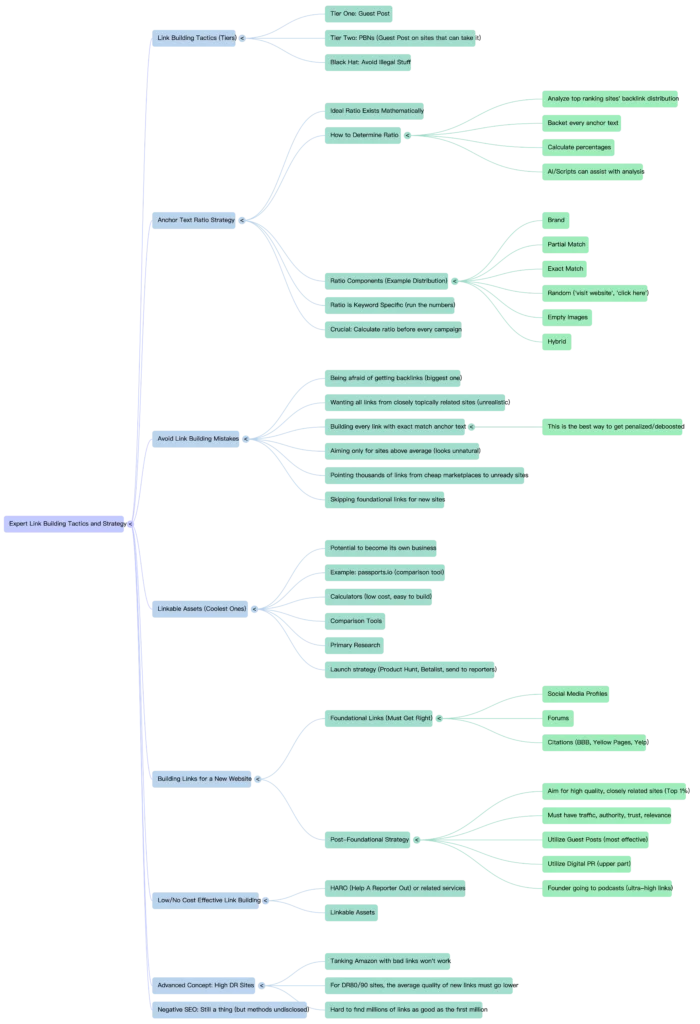
or you can use https://gemini.google.com/ or https://notebooklm.google/ learn this article , it will be more relax
1. How to Use This Manual
This playbook is designed as an operations manual for professional SEOs who want to move beyond “build some links” and into systematic, defensible link acquisition.
If you want a primer on on-page, technical, and content basics, read this playbook alongside
Google’s SEO Starter Guide.
Rather than a random list of tactics, it connects:
- Strategy and risk frameworks
- Tactics and execution
- Anchor text math and governance
- Measurement, dashboards, and SOPs
If you’re already comfortable with core SEO concepts and want to turn link building into a repeatable growth machine, this is for you.
For foundations on how strategy, tactics, and execution fit together, see
Section 1.3: Structure of the Playbook.
1.1 Target Reader & Prerequisites
This playbook is written for SEO professionals who are past the beginner stage and already accountable for results, budgets, or processes. If you’re expected to explain why a link building strategy will work — not just “send outreach emails” — you’re the target reader.
If you need a definition-level introduction to link building itself, see also:
Who this is for
You’ll get the most value if you identify with at least one of these roles:
- In-house SEOs
- You own or heavily influence organic growth for a single brand.
- You need to justify link budgets to marketing leadership.
- You must align link acquisition with product, content, and PR.
- Your core challenge: turning scattered tactics into a predictable acquisition system that matches your company’s risk appetite. See the risk framework in
Section 3.4: Choosing Tactics by Risk Appetite & Industry. - Agency owners / SEO leads
- You manage multiple client accounts and small teams.
- You need repeatable processes, clear reporting, and realistic client expectations about speed, risk, and cost.
- Your challenge: standardizing link quality across accounts while adapting to different industries and budgets.
Section 11: Measurement, Reporting & SOPs is written with you in mind. - Link building managers / outreach leads
- You oversee prospecting, outreach, and placement volume.
- You coordinate writers, VAs, and junior link builders.
- Your challenge: moving from “hit a monthly link quota” to campaigns designed around anchor ratios, risk, and long-term authority.
See Section 4: Anchor Text Ratio Strategy.
If you’re a junior SEO or outreach specialist, you can still use this manual. Treat it as a roadmap of how senior-level link strategy works and where your day-to-day tasks fit into the bigger system.
Required foundations
You don’t need to be a technical wizard, but you should be comfortable with:
- Basic technical SEO (crawlability, indexation, status codes)
→ See Crawling & Indexing basics in
Google’s SEO Starter Guide. - Mapping keywords to intent and page types
– this connects strongly to anchor planning in
Section 4.5: Campaign-Level Anchor Planning. - Basic outreach mechanics (how to pitch, follow up, and log results)
– later expanded into operational SOPs in
Section 11.3: Standard Operating Procedures (SOPs).
1.2 Outcomes & Use Cases
By the time you’ve implemented this manual, you should be able to design, run, and defend link building programs like a senior SEO.
You’ll be able to:
- Design long-term link acquisition strategies
- Move from “we need more links” to a 12–18 month roadmap tied to business goals.
- Select the right mix of tactics from the tiered system in
Section 3: Tiered Link Building Tactics System. - Translate strategy into concrete campaign plans:
- Target pages and topics
- Anchor ratio targets (see Section 4)
- Link velocity and risk limits.
- Audit existing campaigns and diagnose issues
- Understand why a campaign stalled:
- Wrong pages targeted?
- Over-optimized anchors?
- Links from the wrong types of sites?
- Use the remediation flow described in
Section 5: Classic Link Building Mistakes & How to Fix Them. - Build a prioritized remediation plan instead of random fixes.
- Train junior link builders with senior-level processes
- Turn your tacit knowledge into:
- Checklists and SOPs (Section 11.3)
- Tracking sheets (Section 12.2)
- Outreach templates (Section 12.3)
- Help juniors understand:
- How to qualify prospects (Section 3.1.1)
- How to pick anchors that respect ratios (Section 4.5)
- How to QA placements (Section 11.3).
1.3 Structure of the Playbook
This playbook is structured the way a working SEO operation actually runs:
- Strategy → define the rules of the game
- Tactics → choose the plays that fit your risk and industry
- Execution SOPs → turn those plays into checklists and processes
- Monitoring & iteration → measure, defend, and improve over time
At a high level:
- Section 2 gives you the strategic foundations:
when links help, when they don’t, and how link building interacts with digital PR and authority building. - Section 3 defines the tiered tactics system and how to choose your mix.
- Section 4 gives you the anchor text math and governance to avoid over-optimization.
- Sections 5–10 tackle mistakes, linkable assets, new sites, high DR sites, and negative SEO threats.
- Sections 11–12 bundle measurement, reporting, SOPs, and templates to operationalize everything.
You don’t have to read linearly. Many experienced SEOs will:
- Skim Section 2 for context
- Jump straight to a pain point (e.g., anchors in Section 4, or new sites in Section 7)
- Then circle back to define SOPs in Section 11 and templates in Section 12
2. Strategic Foundations of Modern Link Building
2.1 Why Links Still Move the Needle
Modern ranking systems are complex, but one thing has stayed consistent:
high-quality links act as both trust signals and discovery signals.
For a concise overview of how Google treats links and anchor text, read:
You can think of links as a weighted combination of:
- Authority – who is willing to cite you?
- Relevance – in what topical context are you being cited?
- Discovery and freshness – how often and where are you newly cited?
Content and links are intertwined:
- Content determines whether you deserve to rank.
- Links determine where you rank among pages that deserve to be there.
- User signals (CTR, engagement, returns) determine whether you keep that position.
When you set strategy (see Section 3.4), you’re deciding how to acquire these signals in a way that’s:
- Sustainable for the business
- Aligned with risk appetite
- Operationally realistic
2.2 When NOT to Build Links
There are situations where building links is at best wasteful and at worst harmful. Before rolling out any campaign, review this section alongside the pre-link checklist in
Section 7.1: Pre-Link Technical & Content Checklist.
Avoid heavy link acquisition when:
- You have thin or duplicated content
- Pages are short, generic, or purely AI-spun with no added value.
- Large sets of near-duplicate city/service pages exist purely for keywords.
- Core templates (category/product pages) are empty or weak.
- Fix first: content quality, information architecture, and internal linking. See Google’s guidance on helpful, people-first content:
- Critical technical issues are unresolved
- Crawlability or indexation is broken.
- Canonical tags and hreflang are misconfigured.
- JavaScript-rendered content is not properly exposed.
- Fix first: technical foundations, using the same logic as
Section 7.1 and
the SEO Starter Guide.
- You’re pushing obviously manipulative pages
- Doorway pages that exist only to route traffic elsewhere.
- Mass-generated city or keyword permutations.
- Extremely risky YMYL pages (Your Money or Your Life) with weak E-E-A-T signals.
See also: Search Quality Rater Guidelines (PDF).
- The site is in “strategic limbo”
- Domain migration or complete redesign is imminent.
- Brand and product strategy are unclear.
- There’s no internal alignment or support from content / dev / PR.
- In these cases, link building usually has poor ROI because targets and messaging will soon change.
2.3 Link Building vs. Digital PR vs. Authority Building
Understanding how link building, digital PR, and authority building overlap and differ helps you choose the right lever for the job.
Definitions
- Link Building
- Goal: acquire controllable, measurable links to influence rankings.
- Typical tactics: guest posts, resource pages, linkable assets outreach, integration links.
- Measured by: referring domains, anchor distribution, impact on target-page rankings.
A more general primer:
What is Link Building? - Digital PR
- Goal: get media coverage and influential mentions; links are often a by-product.
- Typical tactics: newsworthy stories, data releases, founder stories, creative campaigns.
- Measured by: media quality, brand mentions, branded search, share of voice.
- Authority Building
- Goal: build long-term topical authority and brand trust.
- Typical tactics: expert content, industry reports, conferences, community involvement.
- Measured by: branded queries, natural mentions, direct traffic, speaking/invite opportunities.
If you want to maximize ranking impact per hour, pure link building tactics from
Section 3 and
Section 8 are often your focus.
If you want brand & reputational leverage, you lean more on digital PR and authority-building plays, aligned with the “people-first content” focus in:
Creating helpful, reliable, people-first content.
Priorities by business model & lifecycle
- Local services / small B2B
- Early stage:
- Emphasize foundational links and citations (see Section 7.2).
- Build modest authority via guest posts and industry listings.
- Digital PR is usually opportunistic, not a constant channel.
- Authority building happens via local guides, FAQs, and case studies.
- Content-driven / media / affiliate
- Link building is high priority, especially early:
- It’s often the main way to win competitive commercial SERPs.
- Digital PR via data studies and research can create powerful assets
(Section 6.2.3: Primary Research & Data Studies). - Authority building is reinforced by topical clusters and strong authorship.
- SaaS / product-led
- Early stage:
- Focus on narrative & positioning.
- Digital PR and authority help explain a new category.
- Link building focuses on “use case” and comparison pages, supported by integration links
(Section 8.4).
Budget vs. risk: conservative, balanced, aggressive
Throughout this manual we’ll use three archetypes:
- Conservative
- Focus on:
- Brand links
- Citations
- High-quality guest posts
- Partnerships and integrations
- Best for:
- YMYL, regulated industries, and big brands.
- Tied heavily into authority building and safer tactics from
Sections 6–8. - Balanced
- Mix of:
- Scaled guest posts
- Linkable assets
- HARO / journalist requests (Section 8.1)
- Selective digital PR
- Aggressive
- Heavier use of:
- Large-scale guest posting
- Niche edits (Section 3.1.2)
- Private inventory (Section 3.2.2)
- Requires:
- Strong anchor governance (Section 4)
- Frequent risk reviews (Section 5.5)
- Awareness of link spam in
Google’s spam policies
3. Tiered Link Building Tactics System
This section gives you a tiered mental model so you can:
- Prioritize link types by impact and risk
- Avoid mixing black-hat tactics into otherwise clean profiles
- Align tactics to risk appetite and industry constraints
For how anchors overlay onto these tiers, see
Section 4.5: Campaign-Level Anchor Planning.
3.1 Tier One: Primary Money-Site Links
Tier one links directly move the needle for your core money pages. They’re usually contextual, from relevant pages, and allowed to carry more optimized anchors (within limits from Section 4.2).
3.1.1 Guest Posts (Core White-Hat Tactic)
When guest posts make sense
Guest posting is a workhorse tactic when:
- You need controllable anchors to strategic URLs.
- Your niche has enough relevant sites accepting quality contributions.
- You can consistently produce or outsource good content.
See Google’s stance on link schemes / large-scale guest posting here:
Qualification criteria
Score prospects on:
- Relevance
- Domain topic and target section match your niche or a close adjacent topic.
- Traffic & visibility
- Site has real organic traffic.
- Target pages can rank or already rank.
- Editorial standards
- Structured, readable content.
- Reasonable, contextual outbound linking.
- Author profiles, dates, regular updates.
Using guest posts to shape anchor ratios & topical authority
Guest posts are a primary lever for anchor control (see Section 4.3):
- Use them to:
- Dilute legacy over-optimization with brand and partial anchors.
- Support topical clusters with contextual links to hubs/spokes.
Always plan anchors at the campaign level:
- Include anchor guidelines in briefs.
- Review live posts against the plan in
Section 4.5: Campaign-Level Anchor Planning.
3.1.2 Editorial Mentions & Niche Edits
Definition
Editorial mentions and “niche edits” are links added to existing articles:
- New paragraph referencing your tool/data/guide.
- Updated resource list including your asset.
- Replacement of outdated references with your content.
Advantages
- Faster than creating full guest posts.
- Often placed on pages already indexed & trusted.
- Great for reinforcing assets from
Section 6: Linkable Assets.
Risks vs. full guest posts
- Less control over page and future edits.
- Risky at scale if you buy edits on low-quality networks (link schemes per
Google spam policies).
Treat niche edits as a supplement to guest posts and asset outreach, not a replacement.
3.1.3 Digital PR & Brand Mentions
Digital PR can generate extremely powerful links and mentions.
Story angles that generate links
- Data-driven stories (see Section 6.2.3)
- Emotionally compelling stories: counterintuitive, myth-busting, contrarian.
- Founder/brand stories: unique background, failures, non-traditional paths.
Leverage brand searches & unlinked mentions
As brand demand grows:
- Ensure branded searches resolve into authority pages (see Section 6.4).
- Monitor and convert unlinked mentions into branded links via simple outreach.
Over time, these brand signals reinforce the authority-building role described in
Section 2.3.
3.2 Tier Two: Supporting Links
Tier two links are supporting signals: they don’t usually win competitive SERPs alone but are crucial for natural profiles and new sites (Section 7).
3.2.1 Pillow Links & Brand-Building Links
Types
- Social profiles (Twitter/X, LinkedIn, YouTube, etc.)
- Business listings & citations
- Niche forums, communities, Q&A sites
- SaaS/product listings & review platforms
Roles
- Make your link graph look human:
- Mix of brand, URL, and generic anchors.
- Presence wherever real businesses would appear.
- Support brand queries as in
Section 2.3.
3.2.2 PBN-Style Assets & Private Inventory
This is a risk framework, not an instruction manual for PBNs. Deceptive link manipulation is risky and can violate Google spam policies.
Many mature SEO operations have private inventory:
- Old projects, small blogs, partner sites with real users.
Managing risk
Avoid obvious network footprints:
- Identical layouts & themes
- Shared hosting/analytics footprints
- Excessive outbound links to the same money sites
If you use private inventory:
- Treat each site as a real project with its own value.
- Limit links to:
- Contextually appropriate mentions.
- Reasonable frequency and diverse anchors per
Section 4.
3.3 Black-Hat & Illegal Tactics (What NOT to Do)
Avoid entirely:
- Hacked / injected links
- Large automated spam networks
- Identity fraud, impersonation, deceptive PR
Google explicitly calls out paid link schemes and manipulative patterns in:
- Spam Policies for Google Web Search
- Manual actions report: Unnatural links
- Nofollow / sponsored / ugc link attributes
Document your “do not cross” lines inside your SOPs as per
Section 11.3.
3.4 Choosing Tactics by Risk Appetite & Industry
Consider:
- Industry type
- YMYL vs. non-YMYL
- Regulated vs. unregulated
- Site stage
- New → growing → authoritative
- Risk appetite
- Conservative / Balanced / Aggressive (see Section 2.3)
Then build a tactical mix:
- Conservative → PR, brand, partnerships, high-quality guest posts.
- Balanced → Guest posts + assets + HARO + some digital PR.
- Aggressive → Extensive Tier 1 + private inventory with tight governance (anchor strategy from Section 4 and remediation from Section 5).
4. Anchor Text Ratio Strategy: A Mathematical Framework
Anchor patterns are one of your highest-leverage risk controls.
For Google’s own explanation of link text / anchor text, see:
4.1 Why Anchor Text Ratios Matter for Modern Algo
Modern search systems look for patterns, not isolated links:
- Heavy exact-match anchors are suspicious.
- No brand/URL anchors looks unnatural.
- Off-topic anchors scream manipulation.
Goal:
- Don’t chase a global perfect ratio.
- Approximate what works in your SERP, with a safety buffer.
This connects directly to the remediation in
Section 5.2 and campaign planning in
Section 4.5.
For community deep dives on anchor text:
- Anchor Text: Types & Best Practices (Link-Assistant)
- Anchor Text: The Complete Guide (Erik Emanuelli)
4.2 Ideal Ratio Exists Mathematically
Conceptually:
Ideal anchor ratio = average of top-ranking pages’ anchor distributions (per SERP) ± safety margins
Implications:
- No universal “50% brand, 30% partial, 10% exact” rule.
- Each SERP has its own local normal.
- Your job:
- Measure that normal.
- Decide where you sit (slightly more conservative vs. slightly more aggressive).
4.3 Step-by-Step: How to Determine the Ideal Ratio
- Choose SERP & competitors
- Use primary target keyword.
- Grab top 5–10 ranking pages.
- Exclude Wikipedia-like outliers or irrelevant results.
- Export anchor & RD data
- For each URL, export:
- Referring domains
- One anchor per RD (to avoid sitewide skew)
- Classify anchors
Use consistent categories (reused later in
Section 4.4 and
Section 12.2):
- Brand
- Naked URL
- Partial-match
- Exact-match
- Generic/random
- Image/empty
- Hybrid (brand + partial)
- Calculate distributions
For each competitor:
- Compute % of RDs in each category.
- Then derive:
- Average per category
- Min–max range → your safety corridor
- Set your target bands
Example (fictional):
- Brand: avg 35% → target 40–50%
- Naked: avg 15% → target 15–25%
- Partial: avg 25% → target 20–30%
- Exact: avg 8% → target 0–8%
- Generic & image: fill naturally
These become your governance baseline for
Section 4.5 and
Section 4.6.
4.4 Anchor Text Categories & Example Distribution
Standard categories:
- Brand – “Ahrefs”, “Ahrefs blog”
- Naked URL –
https://example.com/guide/ - Partial-match – contains part/variation of main keyword
- Exact-match – equals the target keyword
- Generic/random – “click here”, “website”, “this site”
- Image/empty – alt text or no visible anchor
- Hybrid (brand + partial) – “Ahrefs keyword research guide”
Fictional safe distribution:
- 35–45% Brand
- 10–20% Naked
- 20–30% Partial
- 0–10% Exact
- 10–20% Generic & Image
Real baselines must be taken from the SERP as described in
Section 4.3.
4.5 Campaign-Level Anchor Planning
To operationalize anchors:
- Analyze current state per URL
- Total RDs
- Current % per category
- Deviation from target bands (Section 4.3)
- Define anchor “budgets” per campaign
- For 20 planned new RDs:
- Pre-allocate how many will use brand/URL/partial etc.
- Ensure cumulative totals stay within safe bands.
- Bake anchor rules into briefs
- Provide anchor pools, not single anchors, in outreach docs.
- Link to internal anchor guidelines in your SOPs
(Section 11.3).
- Review after each campaign
- Compare planned vs. actual.
- If any category approaches or exceeds its upper bound:
- Avoid that anchor type on future links for that URL.
- Use brand-heavy supporting links to rebalance
(Section 3.2.1).
4.6 Building an Anchor Ratio Calculator
A simple Sheets/Notion calculator:
Inputs
- Target URL
- Target keywords
- Current RDs
- RD counts by anchor category
- SERP averages per category
- Your safe bands per category
Outputs
- Current % vs. target band (per category)
- Remaining capacity before hitting upper band
- Alerts:
- If
current% + planned% > max%→ flag red - If brand/URL < lower band → suggest brand-heavy campaigns
This supports:
- Day-to-day outreach decisions
- Risk reviews (Section 5.5)
- Reporting narratives (Section 11.2)
5. Classic Link Building Mistakes & How to Fix Them
Use this together with
Section 10: Negative SEO
to distinguish self-inflicted issues from external attacks.
5.1 Strategic Mindset Errors
- Fear of links
- So scared of penalties that you underbuild for years while competitors compound.
- Unrealistic purity
- Expecting 100% of links from perfectly topical sites only.
- Real brands get mentioned in a mix of relevant and adjacent contexts.
- Aim for topically coherent, not sterile.
5.2 Anchor & On-Page Over-Optimization
Watch for:
- Nearly all external anchors exact-match.
- Titles/H1s/internal links all hammer the same phrase.
- Internal links dense but semantically shallow.
Fix:
- Anchor dilution plan
- Build brand/URL/generic anchors via:
- Guest posts (Section 3.1.1)
- Supporting links (Section 3.2.1)
- On-page tuning
- Loosen titles/headings to sound human.
- Expand depth around related subtopics.
- Improve internal linking to topic clusters.
If over-optimization is combined with link schemes, you risk manual actions:
Unnatural links – manual actions.
5.3 Unnatural Source Profiles
Warning signs:
- Majority of links from high-metric but off-topic domains.
- Bulk packages purchased on cheap marketplaces.
- Velocity spikes unrelated to campaigns or news.
Diagnose:
- Sample 50–100 RDs:
- How many have real content and traffic?
- How many are obvious networks?
- Check time-series patterns:
- Sudden unnatural spikes?
- Correlate with purchasing history.
Use this in audit phase of
Section 5.5: Remediation Playbook.
5.4 Process & Timing Errors
Typical process failures:
- Skipping foundational links on new sites
(Section 7.2) - Measuring only “number of links” with no quality breakdown
- No QA for:
- Indexation
- Linking page traffic
- Anchor and placement context
Fix with:
- Stronger SOPs (see Section 11.3)
- Proper dashboards (Section 11.2)
5.5 Remediation Playbook
- Audit
- Pull full link data.
- Classify by:
- Anchor type (Section 4.4)
- Source quality
- Tactics used
- Triage
- High risk: hacked/spam/obvious networks.
- Medium: low-quality directories, marginal PBNs.
- Low: over-optimized but otherwise decent links.
- Disavow / Dilute
- Disavow clearly malicious & non-removable links.
- Focus on dilution:
- Add high-quality relevant links.
- Add brand/URL anchors.
- Spam policies
- Content policies for Search
- Rebuild
- Reset anchor budgets per URL (Section 4.5).
- Prioritize safer tactical mixes (guest posts, PR, assets, integrations).
6. Linkable Assets: Designing “Cool” Assets That Attract Links
Linkable assets are pages that people want to reference. Instead of pushing links, they pull them in.
6.1 What Makes an Asset Inherently Linkable
Elements of linkable assets:
- Novelty – new or improved vs. existing resources
- Data – original or synthesized numbers
- Utility – calculators, checklists, templates
- Emotion – surprise, curiosity, outrage, delight
- Controversy – defensible but non-obvious takes
They’re distinct from commercial pages:
- Commercial → convert users.
- Linkable → earn citations.
- Use internal links to funnel authority from assets to money pages.
For evolving a successful asset, see
Section 6.4.
6.2 High-Leverage Asset Types
6.2.1 Calculators & Estimators
Great in finance, marketing, HR, etc.:
- ROI calculators
- Budget estimators
- Cost-of-turnover calculators
Useful hooks for:
- Guest posts (Section 3.1.1)
- Digital PR (Section 3.1.3)
6.2.2 Comparison & Aggregation Tools
Assets that save time:
- Product/vendor comparison tools
- Cost-of-living comparisons
- “Best of” aggregators
Prime for:
- Roundup links
- “Best X” articles referencing your neutral comparisons
6.2.3 Primary Research & Data Studies
Data studies power strong PR (see Section 3.1.3):
- Internal product data (anonymized)
- Surveys
- Public data, cleaned & summarized
Key pieces:
- Clear headlines & topline findings
- Simple, embeddable charts
- Angles matched to journalist beats
6.2.4 Interactive Visualizations & Maps
Typical forms:
- Maps showing regional variation
- Interactive charts
- Explorers/dashboards for non-experts
Often earn:
- Embeds (with links)
- Citations in long-form articles
6.3 Launch Strategy for Linkable Assets
Basic playbook:
- Pre-launch refinement
- Smooth UX & fast loading
- Clear copy & examples
- Transparent data sources & update cadence
- Seed audiences
- Product Hunt, Betalist
- Niche subreddits, Slack/Discord communities (Section 8.3)
- Outreach
- Build lists of journalists & bloggers who covered similar topics.
- Pitch angle-first, asset-second.
- Amplification
- Retarget traffic with ads.
- Feature in your own newsletter & partner channels.
- Use as cornerstone reference in guest posts (Section 3.1.1).
6.4 Turning a Linkable Asset into a Micro-Business
Some assets grow enough to justify:
- Their own brand/domain
- Clear monetization (ads, subs, affiliate, sponsorship)
If so:
- Consider a spin-off site.
- Maintain strong cross-links between original and spin-off:
a small internal authority “ecosystem”.
7. Building Links for a New Website: From Zero to Traction
New sites face different constraints than established brands. This section connects to:
- “When NOT to build” in Section 2.2
- Foundational links in Section 3.2.1
7.1 Pre-Link Technical & Content Checklist
Ensure before active link building:
Technical
- Crawlable & indexable
- Clean core templates (home, category, article)
- No major server/redirect issues
See also: SEO Starter Guide.
Content
- Home page explaining what you do and for whom
- About / Contact pages
- Core category/service pages
- 3–5 strong informational or linkable posts
7.2 Phase 1: Foundational Links (Must Get Right)
Goal: prove you’re a real entity.
Core tasks:
- Social profiles with consistent NAP
- Relevant business citations & directories
- Participation in niche communities & forums
These form the Tier 2 link layer described in
Section 3.2.1.
7.3 Phase 2: Post-Foundational Strategy
With basics in place:
- Pick 1–3 primary money pages.
- Build target lists for:
- Guest posts (Section 3.1.1)
- Asset outreach (Section 6)
- Use conservative anchor planning from
Section 4.5.
7.4 Sample 90-Day Roadmap for a New Site
Weeks 1–2: Setup & foundations
- Complete Section 7.1 checklist.
- Acquire 10–30 foundational links.
- Draft a simple linkable asset (e.g., checklist or calculator).
Weeks 3–6: First asset + guest post sprint
- Launch/refine asset (Section 6.3).
- Secure 5–15 quality guest posts pointing to:
- The asset
- High-priority commercial pages with safe anchors
Weeks 7–12: Scale & refine
- Maintain steady guest posting.
- Experiment with low-cost PR:
- HARO (Section 8.1)
- Community promotion (Section 8.3)
- Start anchor tracking (Section 12.2).
8. Low / No-Cost Effective Link Building
8.1 HARO & Journalist Request Platforms
HARO-type platforms let you answer journalist queries for quotes and links.
Workflow
- Set alerts & filters.
- Daily time block for responses.
- Prioritize:
- Topical relevance
- Publication quality
Maximizing each mention
- “Featured in” section on your site.
- Social proof in outreach (Section 12.3).
- Internal links from your own content to those features.
8.2 Leveraging Existing Linkable Assets
If you already have assets:
- Localize or adapt for new markets.
- Refresh data annually and re-pitch previous linkers.
- Create industry- or region-specific slices.
Efficient compounding vs. building new assets from scratch every time
(see Section 6.2).
8.3 Community-Driven Link Acquisition
Approach:
- Be genuinely useful in relevant Slack/Discord/forums.
- Answer questions and occasionally reference your content when helpful.
- Offer co-marketing:
- AMAs, webinars, joint research.
Over time:
- You gain natural citations.
- You receive invites to co-create content that includes links.
8.4 Partner & Integration Links
Key for SaaS/product companies:
- List all integrations/partners.
- Check:
- “Integrations” / “Partners” directories
- Case study / testimonial pages
Systematically:
- Provide strong testimonials.
- Propose joint case studies.
- Ensure your integration pages & docs link back to those partner mentions.
This creates a dense network of semantically related, high-trust links.
9. Advanced Concept: Working with High DR Sites
When your site is already high DR:
- You naturally attract many links.
- Incremental value per link falls.
- Risk from noisy profiles increases.
9.1 Understanding Diminishing Returns at High DR
As DR grows:
- Each new link adds less marginal authority.
- Placement & topical match matter more than raw DR/volume.
You shift from:
- “More links?” → “Which pages/topics lack relative authority vs. competitors?”
9.2 Evaluating High DR Opportunities Beyond Metrics
Don’t trust DR alone.
Evaluate:
- Placement type
- Footer/sidebar vs. in-content vs. author bio.
- Topical match
- DR 60 highly relevant site can beat DR 90 off-topic.
- Traffic & indexation
- Is the linking page indexed, updated, and getting visits?
Tie evaluation into your QA SOP in
Section 11.3.
9.3 Managing Link Velocity & Dilution for Authority Sites
Authority brands inevitably attract:
- Many low-quality links
- Scraper copies
- Spammy mentions
Your strategy:
- Maintain a consistent stream of:
- High-quality editorial links
- Brand/generic anchors
Use periodic reviews similar to
Section 5.5 to decide when to:
- Ignore
- Disavow
- Dilute with better links
10. Negative SEO: Threat Model & Defense
Not all messy profiles are negative SEO, but attacks do exist.
10.1 What Negative SEO Realistically Looks Like Today
Most real attacks use:
- Large-scale spam link blasts
- Massive scraping & content duplication
- Brand abuse (fake profiles, impersonation)
10.2 Why “Matching Millions of Good Links” Is Hard
- Good links are slow & expensive.
- Spam links are cheap & fast.
Search engines know this, so systems aim to:
- Discount obvious spam links
- Avoid punishing strong sites for third-party attacks
Reference:
Your best defense:
- Solid fundamentals (brand, content, healthy link graph).
- Calm monitoring, not panic.
10.3 Monitoring & Detection
Track:
- New RDs by volume, language, country, anchor.
- Anchor anomalies:
- Spikes in spam anchors
- Clusters of foreign-language anchors
Link this monitoring with dashboards in
Section 11.2.
10.4 Response Playbook
- Confirm
- Check traffic & rankings.
- Distinguish noise vs. systemic attack.
- Document
- Export suspicious domains/links.
- Log dates, patterns, screenshots.
- Communicate internally
- Explain:
- What’s happening
- Likely impact
- Planned response
- Disavow / Dilute
- Disavow clearly malicious, non-removable domains.
- Keep building quality content & links:
- Monitor
- Use a 30–90 day window:
- Track whether attack continues.
- Watch for rankings stabilizing or improving.
11. Measurement, Reporting & SOPs
11.1 Core Link Building KPIs
Link & profile
- Referring domains (by quality tier)
- Link velocity (new RDs per week/month)
- Anchor distribution (per URL & category — see Section 4.4)
Performance
- Rankings for target keyword clusters
- Impressions & clicks (Search Console)
- Engagement & conversions per page
Revenue-linked
- Assisted conversions
- Pipeline influence (for B2B)
All feed into reporting in
Section 11.2.
11.2 Campaign Dashboards & Reporting Cadence
Weekly operational dashboard
- New RDs acquired
- Outreach:
- Open / reply / placement rate
- Anchor usage vs. budgets (Section 4.5)
- QA status for new links (Section 11.3)
Monthly / quarterly executive reports
- RD growth
- Keyword cluster movements
- Organic traffic & conversions
Highlight:
- Major wins (PR hits, assets)
- Risk & remediation actions:
- Section 5.5
- Section 10.4
Conclude with next-steps roadmap.
11.3 Standard Operating Procedures (SOPs)
SOPs turn the playbook into repeatable behavior.
Outreach SOP
- Prospecting
- Qualification (quality, relevance, traffic)
- Personalization (recent posts, audience fit)
- Sending & follow-up cadence
- Logging in CRM / sheet (Section 12.2)
Placement QA SOP
Before marking a link as “complete”:
- Check:
- Indexation
- Page quality
- Anchor vs. campaign plan
- Link type (dofollow/nofollow/sponsored — see nofollow/sponsored/ugc)
- Context (not a spammy “links” page)
Anchor Governance SOP
- Define Who:
- Sets anchor bands per URL (Section 4.3)
- Approves exceptions
- Define Triggers:
- Thresholds to:
- Lock exact-match
- Run brand-only campaigns
Share these SOPs with all hires alongside templates in
Section 12.
12. Appendices & Templates
12.1 Glossary of Link Metrics & Jargon
- DR / DA / AS – third-party authority proxies
- RD – referring domains
- Topical authority – combined effect of content coverage, link profile, and user engagement around topics
- YMYL – “Your Money or Your Life”; higher bar for quality
(see Search Quality Rater Guidelines)
Expand internally with your own tool terms.
12.2 Anchor & Link Tracking Sheets
Recommended columns:
- Date acquired
- Source domain & URL
- DR / traffic tier
- Target URL
- Keyword cluster
- Anchor text (raw)
- Anchor category (Section 4.4)
- Link type (dofollow/nofollow/sponsored)
- Tactic (guest post, PR, HARO, asset, etc.)
- Status (live/pending/changed/disavowed)
- Notes
This powers:
- Anchor monitoring (Section 4.5)
- Reporting (Section 11.2)
- Audits/remediation (Section 5.5)
12.3 Outreach Email Templates & Frameworks
Guest post pitch (value-first)
- Focus on value to their audience, not “guest posting”.
- Structure:
- Short intro + why you care about their readers
- Reference to recent article
- 2–3 specific topic ideas
- Proof of quality (samples, credentials)
- Friendly close
Digital PR pitch
- Lead with the story:
- What’s the angle? Why now? Who cares?
- Then:
- Key findings
- Link to full data/asset
- Visuals
HARO-style reply
- One-line intro + credential
- Direct answers (bullets/short paragraphs)
- Optional data points
- Name, role, site
Adapt these to your voice and integrate into the Outreach SOP in
Section 11.3.
12.4 Checklists for Quick Audits
New client link profile audit
- Anchor distribution vs. SERP norms
(Section 4.3) - % of links from low-quality sources
- Evidence of past aggressive tactics (sitewide, heavy exact-match)
- Signs of negative SEO (Section 10)
Pre-campaign risk review
- Target URLs pass Section 7.1
- Current anchors & sources analyzed (Section 4, Section 5)
- Tactical mix matches risk appetite & industry (Section 3.4)
- KPIs & cadence defined (Section 11.1, Section 11.2)
